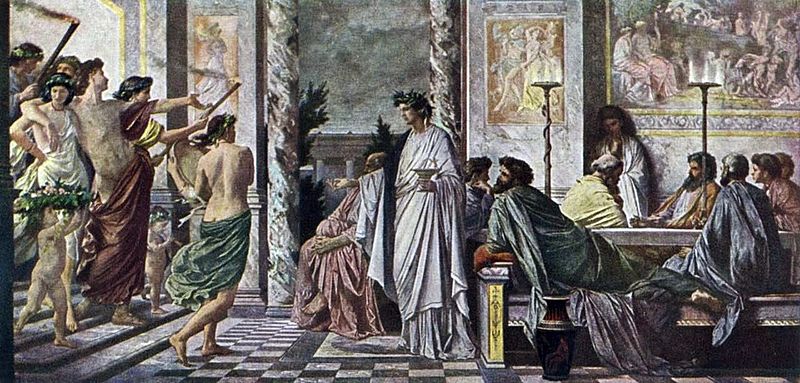
Showing posts with label teaching. Show all posts

Tuesday, December 21, 2021

Some thoughts inspired by the end of another semester

 After such a long time out of the regular face-to-face classroom—here’s hoping it wasn’t just an interlude before a return to Zoom—it was regenerating to be back in the classroom with real people with real bodies, even if I couldn’t quite see their faces. Maybe because I was a bit out of practice or just because I was as tired at the end of the semester as all my students so obviously were, the last day in most of my classes was just a here-have-some-cookies-I-baked-and-let’s-chat-about-the-exam day. Students had few questions about the exam but in all of my classes a large proportion of those who came that last day stayed until the end of class time. I like to tell myself that they liked my company enough that they wanted a bit more of it. It’s much more likely that they liked the company of their fellows or that they just didn’t have anything else to do until the next period began.

One of my classes turned into an AMA. I used to take the approach that I would, under almost no circumstances, let students know my own views on anything, the better to appear evenhanded. As I’ve gotten older and had more years in the classroom, I’ve changed approaches. Now, I am more likely to let students know what views I think are most plausible or implausible. I still do my best to give the strongest arguments for those views that I think are wrong; in fact, I often give more charity to those I’m least sympathetic to and am more critical of those I find appealing. It’s best to trust the students to evaluate my presentation of different views with the background information of where I stand or which way I lean. Anyway, that’s what I’ve come to believe. This change was partly motivated by a student of probably close to a decade ago who asked me in class what I professed, since I was, after all, a professor. Of course, I’m not a professor, but merely an instructor, if I’ve got my current title right, but the point was a good one nonetheless.

So, I was answering questions ranging from what my favorite movie is to what ethical theory I think is closest to right to whether I believe in God or not. Answers to that last one probably disappointed half the class and surprised the other. I don’t know whether it’s because of the way faculty are presented in the contemporary media or because of dross like those God Is Not Dead movies, but students have very clear expectations for what sort of beliefs and ethical and political commitments their professors, especially those in the social sciences, liberal arts, and humanities, are likely to have. As with so much else of our contemporary culture, those commitments are, it seems, supposed to be derived from a very particular party political identity. 

There’s something sad in this, I think, as there is in all pigeonholing. Assumptions about what other people must certainly believe make it harder to connect with them or to learn from them. It flattens others and removes from them their very reasonableness. It’s hard—and maybe harder than before—to see the person in one another, but we have to.  

Tuesday, February 13, 2018

Class thoughts on desire and impermanence


In one of my classes yesterday, we were finishing up our much-too-quick discussion of the basic Buddhist account of the human condition. It’s a class in which students are always asking the right sorts of questions. As I was reiterating the purported relationship between desire or craving and suffering—one that almost appeals to me for Stoic reasons—a student offered the objection that desire can also make our lives better. 
I had been using as an example the way social media and our exposure to the perfectly curated lives of others can make us unhappy. For instance, I had been arguing, when I see the perfect vacation another has taken or I see the interminable post-gym selfies, I can be made unhappy because I have no such vacation but now I desire it or I think my body doesn’t look as good and my desire to look better makes me unhappy.
His response was that, desire at least in the latter case, can be a drive to improvement. Seeing someone else’s success in the gym—though it might also be in a dozen other ways: the publication of their book, a new job, an award—and the desire that follows from it can serve as a goad to effort. That effort itself can lead to greater fitness and the attainment of what one had desired. Surely, in that, there is nothing to cause suffering.
He was right, in a way. There is nothing wrong in ambition or desire insofar as it can lead us to the better if not the good. Epictetus says somewhere in the Enchiridion that we ought to strive but we ought to be realistic about what that striving will cost us and how likely it is that we might fail (and how we will feel if and when we do).
There remains another problem, I said, and that’s impermanence. 
Now, I’ve been thinking about this a lot recently because I injured a shoulder almost three months ago and, though I think it’s finally on the mend after a late trip to the doctor, it has caused me no end of problems physically. And, because the gym plays the role of therapist for me—it is the one hour of the day when I feel totally in control and where I feel like I achieve something—it has caused me quite a bit of emotional distress. It’s not good to be the not-funny kind of obsessive-compulsive.
Whatever your desire leads you to achieve won’t last. The better body will fade with age. The book will be forgotten or surpassed. The next promotion might not come. You will die.
What’s the answer? To enjoy what you have while you have it and even when you’re striving, I suppose, but not to be so attached that you will suffer when it’s gone, or in the case of love to accept the future suffering as part of the enjoyment now. Is that possible? Dunno.
Anyhow, the student had been concerned that the outlook was too pessimistic. I probably took it further.


Tomorrow, for what it’s worth, Hobbes, Schopenhauer, and Ecclesiastes are on tap. Always uplifting!

Tuesday, July 14, 2015

Truth against truth

A few semesters ago, I had a truly brilliant student. He wasn't one of our majors—not that that matters—but he was the kind of student who has a genuine and deep interest in ideas: exploring them, understanding their motivations and justifications, teasing out their implications.
At one point we were discussing the Republic and Plato's blueprint for the education of the Guardians, including his canons of censorship and the Noble Lie. We began talking about whether it was ever acceptable to lie to children (Santa Claus, family myths, etc.) or whether it was necessary always to tell them the unvarnished, if not complete, truth.
Our conversation continued after class and after several more meetings. As it continued, it expanded into related questions.  In the course of thinking through these questions, we got to fiction. He told me that he never chose to read any fiction, because he just couldn't see the point of reading things that aren't true.
In his case, this preference seemed to come from a a certain type of ethical seriousness, one I can admire even if I find it mistaken in its application.
But, in effect, he shared a preference with many in contemporary society. Consider how A Million Little Pieces was first rejected by publishers when submitted as a piece of fiction, but won acclaim and bestseller status when it was published and marketed as a memoir. (And, how it came to be seen as not just a fraud, but worthless, when it was again seen to be a fiction.) This must mean our standards for nonfiction are vastly lower.
"Well," the prospective reader says to herself, "I wouldn't read that, but since you tell me it is a true story, well, now I'm interested."
Or, consider the plethora of memoirs now published, often by people in their 20s and 30s. There was a time when memoirs were written mostly by people of note at the end of illustrious—interesting—lives. Now, people write them when they are still in college. Of course, this reflects the narcissism of our selfie-culture, but they also sell. Apparently, the reading public wants to read these things.
Not only do we want to read them, but sometimes we want to see them made into movies. For one egregious example, consider Julie & Julia. The part of the movie about Julia Childs is watchable. It has Meryl Streep and Stanley Tucci and it's about an interesting person with an interesting life. But what of the other part? And, yet, because it was true-life, it sold as a book and movie. I mean, it actually happened!
Or, consider how a book or television series can add to its appeal by claiming to be "based on a true story" or having tired police procedural plot-lines that are, nevertheless, "ripped from the headlines."
We want truth, even if it's dreck.
This reflects a loss of something of value in our society, one we can regain by thinking about a simple distinction between truth (as positivistic factuality or representation of a state of affairs that obtains in the world) and truth or truths (as something transcendent, both above and below the facts of the matter). Good art often shows us the latter without expressing the former.
Consider Oedipus or The Magic Mountain or Emma or True Stories or the myths of most cultures or so many more. Each of these presents truths about humans, about our lives, our natures, our interactions, our psyches, our ethics. But they do this while being manifestly false. In some cases, they aren't even plausible or life-like.
This is part of the point of Aristotle's suggestion that ethics be learnt from fables or that drama can lead to catharsis, it is what Alasdair MacIntyre was getting at when he said to his students that we should read Austen if we wanted to know how to be, it is how Wittgenstein could deny that there were any ethical propositions even while claiming that Westerns had a moral function.
Of course, there can be art that expresses both types of truth, but it will always be rarer than that type that tells us true stories that tell us nothing about ourselves. If we are honest, most nonfiction is banal, empty, little more than an entertainment masquerading as something profound—and not that good artistically. (And, I am not defending that art that attempts to provide truths while claiming, falsely, to be true.)
What I am declaring is that I am a partisan of fiction and the imaginary and the fantastic. Only in these can we see important truths about ourselves. Without them, we are impoverished, left with only the real. 

Friday, February 07, 2014

On loving teaching

To the relief of my students, we put Plato to rest today. I like to finish up talking about him by talking a little bit about the speeches of Aristophanes and Socrates in the Symposium. Having talked a lot about how reason—and philosophy—can help us ascend to the world of the Forms and into the presence of the Good, it's nice to get a little discussion of love and how it can do the same thing.
We discuss Aristophanes because I find his speech beautiful and a good precursor for other discussions of the need for an other to complement and complete us. And, there's something so damned funny about the idea of eight-legged double-humans rolling around and angering the gods. (That's where Hedwig and the Angry Inch got it.)
Then we talk about Socrates' (Diotima's) account. I don't go into a great deal of detail, because we are doing a survey, but I hit the idea that all love is love of the Good as it is reflected in the object of love, that love begins with love of particular bodies and moves upward, and that all love is a longing for immortality. On that last point, we talk about the way that procreation is a hungering for immortality. And, then I talk about other ways to live on. Usually, I talk about living on through whatever influence I have on my students. 
And, today I told them that I love them. And, I do. It's a hard thing to say, because we so often take love to either be romantic love, or familial love, or the totally banal I-love-you-man non-emotion. We devalue the loves of friendship, I think.
After doing it for sixteen years, I still find teaching absolutely terrifying. I still get sick to my stomach every morning that I have to teach. I still don't know what to do in the minutes before lecture or discussion begins. I'm still as socially awkward in those moments as I am at a party. 
But, I love teaching. I'm not always sure I'm very good at it. But, I'm pretty damned lucky to get to discuss things I get excited about and other interesting ideas with groups of young women and men. And, as I told one class, they are as close to my children as I'm going to have. And, for all of that, I love them.

Saturday, September 07, 2013

Beauty and supervenience

On Monday, I will be lecturing on Plato, as I do near the beginning of each semester. There's something a little like the liturgical year about teaching: the same material comes up again and again, in the same order. And, that can be immensely boring or it can bear me along in a reassuring rhythm, especially when I see something new—with my own eyes or, usually, through the eyes of my undergraduates.
My standard way to introduce students to the theory of Forms is to have them think about beautiful things and what such things have in common that could make them beautiful. This raises a few issues, since most of my students claim to believe that beauty is subjective—they have to be pushed to see that they don't actually judge it this way—and I always have a student or two who wishes to reduce beauty to symmetry or an evolutionary compulsion. 
But, I was also thinking about beauty with regard to one of my other courses this semester. In some ways, no matter how all analogies may limp, beauty seems a near perfect example of a supervenient property, thus an apt case for explaining that notion, as well as multiple realizability, to my philosophy of mind students. 
There's little question (to me) that the beauty of a piece of music or a face or a painting is determined by its physical properties. I know that this is not accepted by all in aesthetics, but it's near enough to true for me. And, any change in the beauty qua beauty of an object would have to mean a change in that object's physical properties. But, a full catalog of the physical properties of Mozart's Requiem or Michelangelo's David would not capture its beauty. There's just no reducing beauty to the physical, for all the determination by the physical. And, it should be obvious that there are many different ways to achieve beauty. So, this looks to me like an easier entree into the concepts of supervenience and multiple realizability than just hitting them with the mental supervening on the physical.
I'm sure introducing these notions through this example will lead to undreamt of nightmares of explication, but in this I have hope.

Saturday, August 24, 2013

Am Anfang

Another school year begins. As I start another ethics class, I've been thinking about the strange—and off-putting—way that so much ethics is taught in colleges and universities. 
Courses too often have three components: 1) An episodic and ungrounded trip through the history of theoretical ethics; 2) A series of outlandish ethical dilemmas, ostensibly to evaluate and criticize intuitions and the positions of those ethical theories; and, 3) A short series of practical applications to issues like abortion and torture.
Most textbooks and readers follow something like this plan, as do most introductory courses. It seems to me—even when I am doing the same damned thing—that this misses on almost all cylinders.
It's very important not to lead students into the genealogical fallacy, but teaching Aristotle without talking about what sort of society 4th-century BC Athens was leaves the students utterly flustered. From there, of course, you have to talk about the way a virtue ethics might be divorced from its context, or better yet married to a new one, but you can't treat theories as ex nihilo. Too often, though, we do. When students can't see what made the categorical imperative live for Kant, there is little hope they can see what might make it live for them.
Then, we ask them questions about fat men trapped in caves, or runaway trolleys, or—Heavens forfend!—unconscious violinists and people seeds. We ask them what their intuitions are in such cases, ignoring the fact that no one has untutored intuitions in these cases. We treat intuitions as if they were themselves ex nihilo, while we really know that we gain them in experience. And, I have just had no experience with people seeds, so whatever my intuitions are they are intuitions about people or seeds.  We act as if there were deep underlying principles for each of a person's moral judgments, when we also think that what we are trying to do is provide such principles. When we do this, we ask them to think that ethics and philosophy is pure and utter bullshit. Then we are surprised when they think it is.
Finally, we try to ground this whole project in talking about controversial issues. But, we talk about the same ones all the time. Who really wants to talk more about abortion in a classroom? How many more times can we rehash the same substandard articles on same sex marriage? Or, animal rights? And, we act as if the issues that we are talking about the most central ones in a human life. But, I am not getting abortions most of the time. That is not where my attitude to human life is made most clear. So, we teach them that ethics, if it can be made about anything, only applies at the edges of life, not in their everyday lived lives.
I don't always think that the teaching of philosophy should try to be useful. Mostly, I think it shouldn't. But ethics is one place where it must be about the real world and the common life. And, I think we fail at that. Or, at least I do most of the time.

Saturday, February 09, 2013

Why does Aristotle have to be so bad on human nature?

Yesterday I finished up my discussion of Aristotle in two of this semester's classes. I am sympathetic to much in the Aristotelian tradition. So, I always try to make him appealing; there is a lot to say in favor of his ethical theory and his theory of the soul comports much more with modern thought and scientific accounts of the place of humans in the animal kingdom than theories of much more recent thinkers. In short, I like him a lot. And, I think he has a lot to offer my students.
But, if we are going to talk about Aristotle's view of human nature, we have to talk about the dark side of his view, too. This is a thinker who thought that women—being men who hadn't fully formed—and "natural slaves" were not fully in possession of reason, the distinguishing mark and telos of humans. Because of this, they can never be fully happy—those men who are capable of such happiness thus have obligations to take care of and correctly utilize women and these slaves and to give them as large a share in human happiness as possible—and we have to say that they really aren't fully human or that they aren't and can't be flourishing humans. That is a sort of elitism that is deeply troubling.
And, this raises two problems: one general and pedagogical and the other more specifically philosophical. 
The first one is how to talk about thinkers or figures who—having had the misfortune of having been born human—were deeply flawed. It is hard to talk about any historical figure let alone a philosophical one—it is the job of philosophers to have opinions—who doesn't have truly horrible skeletons in his or her closet. How can we honestly present them without having the negative parts of their views overshadow the main thrust of their ideas in the minds of students new to their thought? 
The temptation is to gloss over those bumps. At least, I know that is my temptation. But at some point, either during the class or after, at least one student will discover that Heidegger unapologetically joined the Nazi Party, or that Socrates praised Sparta—and that is wasn't quite the same city as that portrayed in 300—or that Mill seemed to favor imperialism, or ... some other view that it was too uncomfortable to cover in class. And, they will wonder then whether there is any point in thinking about them and why exactly I hid it from them. I am assuming that at least some students will continue to think about what we've discussed; that may seem optimistic, but this rare optimism has been borne out in the past.
I don't have a solution, other than to honestly present the warts and try to tease out, with the students' help, whether we can separate the wheat from the chaff. Sometimes, we are able to, sometimes we are not; in either case, some pedagogical purpose might have been served.
The second problem has to do with giving accounts of human nature, so it is both a more narrow question and one with broader implications, i.e., it matters even if we don't spend much time behind a lectern. Since it is probably more important, I have left it to last and will have less substantive to say about it; such is my way. 
Aristotle, like quite a few philosophers, focused his account of human nature—of what is essential about us, what separates us from the rest of the animals—in the faculty of reason. We have reason and the other animals do not. Of course, others have placed that difference somewhere else, whether in language, abstract thought, or someplace else. A problem with any such defining characteristic, apart from a merely biological one, is that it will admit of degrees: some people are more capable of reasoning than others, some people gain only rudimentary language, and so on. If our account of humanity—or personhood, to make it clearly not just biological—ties it to some characteristic that only humans have what does that say about those humans who don't have it or who have it to a lesser degree? In other words, can we give an account of human nature that doesn't end up, as Aristotle's does, being a graded account of that very humanity? How can we make it work—as most surely we must—that even those who don't share to a very high degree in reason or communication or even emotionality—are still fully human and fully persons?
There are a few strategies that have been tried here. One can say that even the person who does not, in fact, share in the capability or characteristic still has it potentially. How that is supposed to work I never quite understand. If I lack a capability and it is, in fact, impossible for me to develop that capability, the fact that my conspecifics have it doesn't mean that I have it potentially. I don't inherit a potential talent for musicality from the fact that some humans have it; yes, it is a characteristic of the species, but not of this member. 
Alternatively, one can try to solve this problem by adverting to souls or spirits. Of course, there are important problems with that as a philosophical move, but let me point out just one. Since I have no evidence of any souls except for maybe my own, the existence of souls will never tell me of a difference between humans and any other animals. I have as much reason to think that my dog has an immortal, or merely mortal, soul as that my partner does, unless I am basing my judgment of soul possession on some other characteristic, but then we are right back to our initial difficulty.
So, the question becomes whether we can give an account of humanity that captures all humans but excludes the animals or whether we are stuck with one of what seem to be two equally unpalatable options: a graded approach even within the species that counts some humans as more human than others; or, the view of Peter Singer and others, that we can make no important distinctions between all humans and the rest of the animals on which we might be able to base, for instance, moral considerations.

Wednesday, September 30, 2009

God, the deceiver

One of the brighter students in one of my classes was hanging around after class the other day and we began to talk about various kinds of idealism. I began to describe the views of Bishop Berkeley, who believed that there are only minds and ideas. That is, he denied that the physical world existed as a physical entity or collection of entities. She was really understanding the view and some of the intricacies of his theory.
So, I wanted to introduce some of the problems beyond the obvious counterintuitiveness of the view. So, I mentioned that Berkeley, as a Christian was committed to the goodness of God. But, I explained, Berkeleyan idealism committed one to viewing God as having endowed our minds with apparent sensory faculties that would naturally lead us to believing that a physical world existed, even though it doesn't on the view. This, I said, would make God into a deceiver.
She responded, "That's sort of like the problem with astrology."
Confusedly, I asked, "What do you mean?"
"You know, like the way that science tells us that the Universe is really old and about the Big Bang, but"
" Oh, you mean, astronomy," I cut in. "So, you mean that the Universe is really much younger, in spite of what science says?"
"Yeah."
Then, I realized that she is a young earth creationist. Now, I have respect for this young woman's intellect and for her hard work and for her ambition to make something of her life.
But, even as I tried to explain to her that, at least as far back as St Augustine, serious Christians have thought that the creation accounts in Genesis cannot possibly taken literally, I was wondering whether it was pointless. I wanted to get her to see that if her religious beliefs require her to believe things that are clearly empirically false, she needs to consider the way in which she holds those beliefs.
But I also realized that when I tried to get them to see the value in seeking the truth, in being reflective, in examining our beliefs and lives, most of my students either don't pay any attention or have so sequestered their lives that some beliefs are not at all revisable.
And, I was sad.

Wednesday, September 16, 2009

Social conventions

Yesterday in one of my classes a student sitting in the front row took out a Q-tip to clean his ears as I lectured. I know that there has been a lot of talk about the coarsening of American society in the context of screaming "you lie" during a joint session of Congress, portraying Obama as Hitler, the blatant racism of many of the tea-baggers—God, I love that phrase—and the town halls. But I really wonder in a world where men and women walk down the street picking their teeth and students clean their ears in class and no one ever removes their Bluetooth devices—seriously, you are not that important—what we should expect.

Thursday, May 15, 2008

More about teaching

So, it's the end of the semester and this means that I am thinking way too much about my classes and wishing, no matter how much I may like some of my students, that the semester would finally end. So this will be another post about class and, alas, about God.
Thus, I will delay for at least a post any discussion of the California State Supreme Court's ruling regarding gay marriage. I think I am supposed to have a public opinion as a gay intellectual (?). My dream, of course, is to be a public intellectual, but there aren't enough openings right now.
Today, in one of my classes, we were doing a bit of review. And the topic turned to God and the difference between revealed and natural religion. I was explaining the distinction and how it is possible to get from natural arguments for God's existence—assuming they work—to a position of choosing which purported revelation might be best as a student interrupted to ask me whether I personally believe in God. I noted that this was irrelevant—in any case, as I was telling my friend and colleague Kevin (I hope I can call him a friend and I'm at least an adjunct colleague) yesterday, my views on God and what "belief" means when applied to the supernatural are a little much to explain to an introductory student, i.e., more than anyone would want to know—and that we were talking about other people's arguments and not my views.
He interrupted me again, to point out that I ought to believe in God, that he was the Son of God and that he was here to love us all. I herded him out; he was dressed all in white flowing robes and I was scared witless. There are great days in the college classroom and then there are days where I wonder if I shouldn't be armed. They killed Socrates, after all.

Wednesday, May 14, 2008

On the other hand

Since I was just complaining, I also got a number of real—not just last-minute grade grubbing—thanks and handshakes and even one thank you card and a nice little gift from my introduction class that had its final today. That is always a gratifying experience: to be reminded at the end of a semester when you are sure that they must long for your absence, that you may have actually connected with a student or two. I even inspired a few to minor or major in the love of wisdom. So, teaching has its moments, too.

End of the semester frustration


While giving an exam today, I powered through the grading of just over twenty short papers on the existence or non-existence of God. I was in a zone and I want the semester to be over. It was the second set of papers about the same topic I had read this semester, and I was reminded of two things: 1) it is unwise of me to teach two versions of more-or-less the same class with totally different structures—granted they are taught at different institutions, but...; and, 2) I ought not to assign God as a paper topic, as it always depresses me.
The one that hit me the hardest today, was the one that informed me that the author's life was eternally happy because of her belief in God and that I, too, could be happy if I were to believe in God. So, I learned from this that my student believes that theism is a guarantee of happiness—apparently not all Bibles still contain Job and not all Christians were raised in the same tradition of 2000 of thinking over problems like suffering as I was—that she believes that the self-deprecating manner I affect in class is truly a reflection of a deep and abiding unhappiness and she assumes that she knows that I am an atheist or at least an agnostic. I take it that they teach youngsters in certain types of churches to evangelize all people at all time, but I wasn't in need of it—and it won't make me happier.

Wednesday, February 13, 2008

What I do


I'm not a particularly good philosopher. At least I wouldn't claim to be. But there are days standing in front of 40 young adults when I feel like the father of philosophy himself. Of course, it is not that I am like him in his reputation or greatness. Rather I am like Socrates in front of an Athenian jury on the day of his trial.
I say relatively absurd things, things that go right against common sense (some of them are things I even believe), things that make my students relatively unhappy. I try to convince them that they don't really know what they think they do and that, although it is of the greatest import that they give reasons for their beliefs—something that they are barely convinced of themselves—their beliefs are largely baseless. Then, like Socrates himself, I tell them that though they are unhappy, I am really making them happy.
Today, in the midst of an explanation of why Lord Russell thought that we were, after all, justified in thinking that the material world exists after two weeks of force-feeding them skepticism, one of the students muttered, "Jesus". I had to reply that He wouldn't be able to help them, at least in understanding Russell; they just didn't get along after Russell wrote Why I Am Not a Christian.
One of these days my coffee is going to taste of Hemlock.