Wednesday, June 11, 2014

Is it right to do what you have a right to do?

A common argument form, at least in the American context, goes like this:

  1. I have a right to x.
  2. It is right to exercise one's rights.
  3. Thus, it is right to x.
  4. A right that is not exercised may disappear.
  5. Thus, I should x, on pain of losing the right.


For sake of illustration, substitute the following for x: "carry a firearm into Chipotle," "use a racial/sexual/national epithet," "express the opinion I have formed without any evidence or reflection," "ridicule people with beliefs I take to be irrational," etc. It's left as an exercise for the reader to find other substitution instances. 

We have all heard arguments of exactly this form when someone obnoxiously and pointlessly does something he may very well technically or legally have a right to do. "But, I have a right to!"

I don't think we are the only ones who argue this way, or at least implicitly accept this argument form. In fact, I think it occurs in any culture that has taken rights to be the central category around which morality revolves and upon which society rests. That may mean that all of us who live in a post-Enlightenment world will tend to find this sort of argument sympathetic. 

Insofar as we make this type of argument or find it compelling, we are dooming ourselves to a non-civil society. And, maybe we are providing a reductio of the (centrality or primacy of a) notion of rights.


Monday, June 09, 2014

Of dread and power

I've just read—maybe re-read, since I'm not sure—Thomas Merton's Contemplative Prayer. My library and interests are eclectic, to say the least. I had forgotten, if I ever knew, the connections Merton draws between his own analysis of religious contemplation and the existentialist account of absurdity and angst. In some ways, he sees contemplative prayer as a Nietzschean staring into the Abyss and waiting for the Abyss—in this case the ineffable Ground of Being—to embrace one. One of his central themes is dread.
This is something I know a lot more about than I do any mystical experiences. There was that one time I had something religious-experience-adjacent when walking the streets of my hometown trying to fix the adolescent depths of obsessive depression and, seeing a slug cross my path, I tasted sublimity. That was a one-off experience. Overall, my life experience has been more one of obsessive depression than of the sublime. But, I know dread, if only on one side.
For me dread is a recognition of lack of control. It is different to Sartrean anxiety at the absolute responsibility that comes with every choice, though I sometimes can be paralyzed by that, as well. Instead, it is a feeling that much of my life and what I value is determined by factors entirely out of my control, a recognition of the vicissitudes of Fortune. And, perhaps, a sub-rational belief that there is a way to counteract or control Fortune. 
I could give any number of examples, but the one closest at hand is the process we are currently in of selling our home and buying another. We have done our part. And, we have done it pretty well, it seems. What ultimately happens, however, depends on the actions of a number of other people: our buyer, our seller, our agent, the agents of both other parties, friends and relatives who might influence the buyer and seller, other people who might—in butterfly-effect ways—impact upon the lives of all these people. And, we have no control over any of these people. Of course, there could also be a number of natural events or disasters or water main breaks or who knows that could affect the whole mess in any number of ways.
If it seems like I've worried too much about this, I am a master of worrying. It runs in my blood and I have years of practice doing it.
Since, there are so many parts of this process—and everything that happens in my life—the rational thing would be not to worry. Or, rather only to worry about those parts of the process over which I can have some control or at least influence. Worrying about the rest of it seems counterproductive. The part of me that admires the Stoics tells me this is what I should do.
I should just give up the worry and let the rest of the world take care of itself. If things work out, well. If they don't, I have done my part. But, not worrying leads to an even deeper dread. A greater anxiety. I probably admire the Stoics because they preach something I cannot achieve.
What purpose does the anxiety serve? Why worry? I think the worry is an attempt to control—in some way—what cannot be controlled. To admit that it is all out of my control is too much; it's to admit to a helplessness that I cannot abide, or that I know is there but I have to ignore. But to worry about it and to worry about it constantly, though it too is a kind of dread, is to hold it all together in my mind. And, if I can hold it together in thought, then that is almost, almost, like willing it together.  To let it slip my thought is to let it be the chaos I really know it is. Of course, my worrying doesn't have this effect. The Secret doesn't work. But, a kind of mental order substitutes for the order that is missing in the messy, the chaotic, world.
The dread of constant worry is horrible, but it is less horrible than the dread of powerlessness and insignificance even to those things that matter most to my own life and my subjective enjoyment of it.
I have more to say, in another context, about the attempt to put order on a world that lacks it, but I'll save that for later. 

Tuesday, June 03, 2014

Of Aristotle, monks, gods, and beasts

It's summertime and the living, so they say, is easy. Or, it's easier than it is during the academic year. if it weren't for the stresses of (at least an attempt at) moving house, I wouldn't be having any anxiety dreams at all. At least they mostly aren't about teaching at the moment.
So, I have some time to read for pleasure. And, at the moment I am re-reading—apart from the four or five other books I'm in the middle of—Patrick Leigh Fermor's A Time to Keep Silence, an account of a number of sojourns among monastics.
He is at pains to make his reader see some sense in the notion of a contemplative live as more than just a useless or slothful one. This is a hard thing to do in a world that has been so deeply influenced by the combination of our Reformation heritage, a utilitarian outlook, and secularism. The first tells us that monasteries are dens of iniquity and escapism. The second tells us that contemplation can only be of value if it is of use. And, the third tells us that it can be of no use, as the world to which it is directed does not exist.
I'm not going to defend monasticism here. But, there is something to say—or can it be said?—about contemplation.
When I teach Aristotle's Nicomachean Ethics, parts of which I discuss almost every semester, I take one standard approach to his account of the best life for humans.
He says that the ideal, the perfect, life for a human being would be one of pure, philosophical contemplation. This is the life that most fully engages the highest part of us, our reason. It is the activity that brings us closest to (the Aristotelian) God. It is, he says, a divine activity in which we participate in immortality. This is not, for him, because it makes us immortal but because we grasp undying truths. Or, this is what it seems he means, since immortality doesn't really seem to be on the table for Aristotle.
As I said, I take one standard approach to discussing this, which is to say that I tell students that Aristotle probably shouldn't have said what he says, since he then seems to take it back by devoting the rest of his account to the second-best life of practical reason. And, of course, he seems to set up the contemplative life as inaccessible for most people and inconsistent with their flourishing. It is both the most pleasant of all activities and one that would not be pleasant for most people. And, pure contemplation is valued, partly, because it is self-sufficient. Yet, this seems to set the contemplative up as someone who does not need society. But, without society, Aristotle tells us, we become either gods or beasts. And, the implication is that most of us become beasts. Finally, the contemplative life fully realizes our desire to understand, but seems to ignore our desire to be active.
So, I tend to treat this emphasis on the contemplative life as a throwaway comment, safely ignored in a text that is, after all, supposed to tell us about how to live. It is a work in ethics, after all.
But, I fear that I make a few pretty important mistakes in doing this. In the first place, I am telling students that unless they can find an application for something, unless they can find it practical, it has no value. In other words, I am playing into that good old American utilitarian pragmatism that is not so slowly strangling philosophy as a discipline.
More specifically, I am telling them that pure contemplation, thinking for the sake of thinking—and, by extension, reading for the sake of reading—is of no value. The mind is but a tool and never to be fed for its own sake.
And, I am telling them that there is no point is having an ideal that they may not be able to reach. That there is no value in aiming at something beyond themselves. This one may not be as clear, but if I am telling them that the contemplative life is to be devalued because not everyone can achieve it, that is an insidious sort of leveling.
Contemplation, pure thought, may just be valuable because it isn't intrinsically valuable, because it doesn't have an aim outside itself, because it is a practice that can only have value from the inside.  And, it's hard. Most people won't achieve it, but they get some good—one only they can see and one primarily for themselves—in trying, because what they are aiming at is a good in itself. And, after all, that fits with what Aristotle says about the goodness of any life. So maybe I need to start pushing the pointless precisely because it is pointless to anyone not engaged in it.

Monday, February 24, 2014

What Alec Baldwin could have said

Instead of this, what if Alec Baldwin had just said:

"Anyone who has followed my career over the years knows that when someone affects my family I get angry. I'm an imperfect human being. And, when I get angry, I sometimes do and say things I shouldn't. I can't promise it won't happen again. That's not a fact I'm proud of, but it also doesn't define me. Anyone who has followed my professional and philanthropic work knows there is much more to me. I am sorry, but I ask that people judge me on the larger picture. Thank you."

Sunday, February 23, 2014

Farm-trucks and firearms

We live in a society and time when the odds that you will die as a result of interpersonal violence are lower than they have been in all of human history. And, we also live in a time when more and more people are claiming a need to carry concealed weapons with them everywhere: churches, bars, schools, private businesses, public spaces, etc. 
More than half the men I see on campus or in a store are displaying the clip of a so-called tactical knife on their pants' pocket. Are they secretly SEALs? 
In spite of the sensationalism of the media and the overstatement of the dangers of the world from left and right—it's not a Hobbesian state of nature out there and the New World Order is not right around the corner—we are safer than we have ever been and many of us feel more need to protect ourselves.

Similarly, we live in a society and time when fewer of us live rural lives than any time in human history since the development of agriculture. Yet, I see more people driving Silverados and F-150s than I ever saw in the rural community where I grew up. Of course, in farming communities people tend to leave the farm truck on the farm and drive the car into town; something about pig shit in your truck makes it less presentable.
We have less need of large-bed trucks than ever, and now we drive them as luxury items. It cannot be because they are needed or because of their convenience in cities.

I think both phenomena are related. We live in a society where we are less and less self-sufficient. And, where what we do doesn't produce anything tangible, certainly nothing tangible that directly impacts our own lives—apart from money. You don't have to be a Marxist or influenced by Rousseau or a devotee of Ayn Rand to think that there's something in our nature that strives for autonomy and production and a sense of self-sufficiency. And our society doesn't provide much of any of that.
But a firearm or knife or farm-truck or pair of cowboy boots or even home brewery can signal, to some small degree, that I am after all in charge and capable of taking care of myself. It might still be a fantasy, but no less psychologically important for all that.

Friday, February 07, 2014

On loving teaching

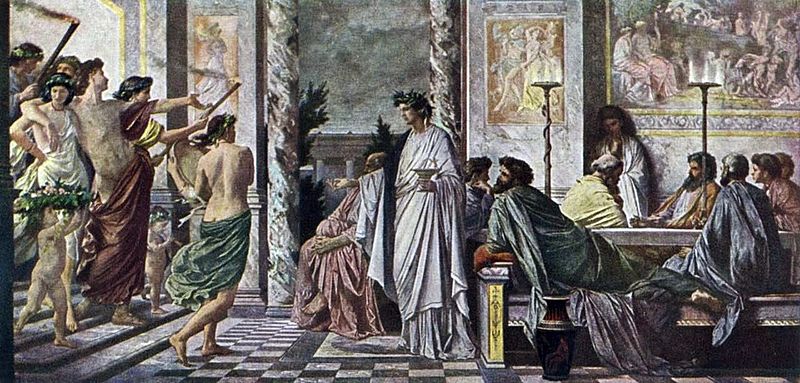
To the relief of my students, we put Plato to rest today. I like to finish up talking about him by talking a little bit about the speeches of Aristophanes and Socrates in the Symposium. Having talked a lot about how reason—and philosophy—can help us ascend to the world of the Forms and into the presence of the Good, it's nice to get a little discussion of love and how it can do the same thing.
We discuss Aristophanes because I find his speech beautiful and a good precursor for other discussions of the need for an other to complement and complete us. And, there's something so damned funny about the idea of eight-legged double-humans rolling around and angering the gods. (That's where Hedwig and the Angry Inch got it.)
Then we talk about Socrates' (Diotima's) account. I don't go into a great deal of detail, because we are doing a survey, but I hit the idea that all love is love of the Good as it is reflected in the object of love, that love begins with love of particular bodies and moves upward, and that all love is a longing for immortality. On that last point, we talk about the way that procreation is a hungering for immortality. And, then I talk about other ways to live on. Usually, I talk about living on through whatever influence I have on my students. 
And, today I told them that I love them. And, I do. It's a hard thing to say, because we so often take love to either be romantic love, or familial love, or the totally banal I-love-you-man non-emotion. We devalue the loves of friendship, I think.
After doing it for sixteen years, I still find teaching absolutely terrifying. I still get sick to my stomach every morning that I have to teach. I still don't know what to do in the minutes before lecture or discussion begins. I'm still as socially awkward in those moments as I am at a party. 
But, I love teaching. I'm not always sure I'm very good at it. But, I'm pretty damned lucky to get to discuss things I get excited about and other interesting ideas with groups of young women and men. And, as I told one class, they are as close to my children as I'm going to have. And, for all of that, I love them.

Sunday, January 19, 2014

Do I represent the human condition?

Last year I had the pleasure to teach a class on 20th Century Continental Philosophy. I’m not sure that I have an area of expertise, but Continental philosophy certainly isn’t it. The class involved me having to learn and read a lot of new things. And, I cheated a little by starting with reading Nietzsche—I mean, he almost made it into the 20th Century, right?
Among the things we read was Sartre’s novel Nausea. I’m not particularly sympathetic to Sartrean existentialism, but I do find an affinity with his sense of despair. That’s a problem, though.
It’s not a problem peculiar to Sartre, but one he shares with any number of philosophers. Where it begins I don’t know. It seems to be particularly endemic after the end of the modern era, after the end of the great system builders who attempted to achieve objective, perspective-less truths. You see it in Kierkegaard and Schopenhauer, but it is also there in Rousseau, Hobbes, and even the Buddha and the ethical views of Plato and Aristotle. It is simply to see oneself as a fully-representational map of the cosmos—or, at least of the human condition.
What I mean is this: Sartre sees his life as one filled with anxiety and despair. And, he draws the conclusion that this is the human condition. It might well be. Of course, it would take argument to establish that. And, I won’t deny that Sartre supplies argument. But it still looks as if the argument isn’t driving the conclusion, it’s in service of a pre-established sense that all lives are like Sartre’s. Mightn’t he be exceptional?
You see this when a student—or a group of students—reacts to Sartre by saying, “Yeah, but life really isn’t that bad.” What the Sartrean has to say is that the student hasn’t really looked very hard at her life. And, unless the student can be brought to despair, we have evidence that she isn’t reflective.
The same goes for the student who responds to the Buddha by saying that, in fact, all existence isn’t suffused with suffering. Or, who reads Schopenhauer, and thinks that there really are other drives than the will to continue existing. And, so on.
That’s not too different to telling the patient that, of course, he doesn't remember the Oedipal conflict, but it occurred nonetheless. There’s just something funny going on there.

There’s a temptation for all of us to see our own experiences as somehow universal—I am often tempted to think that my neuroses are really the result of being more in touch with the real human condition, but I don’t really matter, nor do my views. This temptation is understandable, but it is a fatal flaw in a philosopher to take her own life as the paradigm case of what a human life is like.